Tuesday, November 10, 2020

How do Animals Damage Your Trees in Winter?

Written by Admin and published on https://www.treeandlandscapecompany.com/.

While it is amazing to see how winter wildlife prepares and survives the brutal cold, snow, and ice of Wisconsin winters, it is also a nuisance in the spring to see how trees and animals affect each other in the winter. Animals such as deer, squirrels, rabbits, and chipmunks are just a few of the creatures active year-round and live in the cold.

During the spring and summer, we are often protecting those plants most susceptible to our gardens. We add wire around our hydrangeas and rose bushes to prevent deer from chomping on new growth, buds, and fully developed segments. Similarly, we inspect our gardens for holes and burrows where rabbits, moles, and voles are seeking inhabitance. We tend to take preemptive measures towards protecting our smaller plants, and often overlook protecting our trees in winter.

Protecting Trees from Animal Damage

It’s fall, and wild animals are on the move! Whether they’re migrating, gathering food for the upcoming winter, or acting up for mating season, you’re bound to see more wildlife in your back yard. In fact, every species from the tree squirrel to the black bear have been known to investigate our neighborhoods at this time of year.

While we all enjoy the wildlife associated with more natural surroundings, their impact on our landscaping efforts can be severe. Now is the time to act to protect your trees and shrubs from animal damage.

You’ve probably put a lot of time and effort (and probably money) into your landscape. These tips can help ease the pain of fall and winter on your plants, while still enjoying our native wildlife.

Only a small number of animal species will cause significant damage to trees. The animals most likely to cause damage in the Rocky Mountain region include deer, elk, porcupines, beaver, mice, squirrels, gophers, rabbits, and birds.

Animal Fencing and Tree Wraps:

Fencing is a commonly used method for controlling larger game animals from damaging your trees. Trees can be wrapped individually, or fenced off in groups depending on your needs. While this type of fencing can be expensive, it is an excellent long term solution to tree and garden damage in areas where deer and other large mammals are prevalent. Fencing can be left up year round, or taken down during the summer months where the animals pose less of a threat to smaller trees.

For smaller animals such as rabbits or beaver, individual tree guards or trunk wraps will be more effective. These can be made with wire screen, burlap, or other flexible but heavy duty material that will discourage gnawing or rubbing on the base of the tree.

elk-damage

Antler rubbing of tree bark, broken or damaged branches from eating foliage and tree girdling are among the more commonly seen damage in our area. This damage can leave the tree more susceptible to diseases and insect infestation, as well as stunting the growth and regeneration of the plant.

Repellents:

There are plenty of ready-made repellents available to deter rabbits, deer and mice from feeding on trees. While some contain fungicides, others are loaded with natural predator scents. Discouraging the animals from wanting to be near the tree, or providing an unpleasant taste if they do decide to give it a try.

Repellents should be applied regularly for best results.  Rain or snowfall, wind conditions, as well as time break down the effects of any repellent. Apply repellents on a dry day, preferably when the temperature is above freezing.

porcupine-in-spruce-tree

To control mice or vole damage, coat the base of the plants thoroughly. Rabbits and larger rodents will feed on all parts of the plant so the entire tree should be treated to two to three feet above the snowline if possible. Porcupines and squirrels tend to frequent the higher parts of the tree, and therefore hanging repellents or treating the entire tree may be necessary.

As with most things in life, an ounce of prevention is worth a pound of cure! This definitely rings true when it comes to protecting your trees and landscape from wild animals. While most trees will recover from the damage, the visual impacts and stunted growth cycles are irreversible. If you are unsure of how to best protect your trees and shrubs this season, contact your local landscaping professionals for help.

Original post here https://ift.tt/3n8MQzI.


from Cairns Tree Lopping Pros https://ift.tt/3phdS9S
via IFTTT

How Canopy Thinning Can Keep Your Trees Healthy

Written by Admin and published on http://www.treeserviceyorkpa.org/.

When was the last time you hired a tree trimming service near Atlanta? If it’s been more than a year, then the trees on your property may be overdue for maintenance. For several reasons, tree pruning and trimming are important parts of tree care . First, these practices can help your trees produce more fruit and flowers, and they may also improve their growth and appearance. More importantly, tree trimming to prevent the canopy from becoming too dense may promote the health of the plant.

To remain healthy, trees need to get plenty of sunlight. If their canopies become too dense with branches and leaves, then this can prevent necessary sunlight from filtering through. Also, sufficient air circulation can be critical for preventing a host of tree diseases. When a tree’s canopy grows too densely, this may reduce air flow and promote the growth of fungi and bacteria. For these reasons, hiring a tree trimming service for canopy thinning may help keep your trees healthy.

Tree Canopy Thinning in Atlanta, GA

Thinning Tree Canopies For The Health Of The Tree

Tree thinning is the removal of live branches at the outer canopy that is duplicating or crossing.  This is done to improve air movement and light penetration. It also lessens the weight of heavy limbs.

Older trees must have no more than 1/3 of live foliage eliminated when thinned. Thinning tree canopies for the health of the tree is also good for the health of the surrounding shrubs, lawn, and trees.

The splendor of a healthy tree can’t be devalued. Trees provide shade to the garden, offer wildlife habitat and create a natural barrier against nosy people. Though, the pretty little tree you planted years ago can flourish to become a beast, shadowing all other life below and making a moonscape of patchy sod and leggy plants.

To improve your tree’s health and for the well-being of lower story plants, you have to sometimes thin the canopy to let in air and light. You don’t have to be an arborist to know how to thin out a tree’s canopy, but some tips are helpful.

Canopy Thinning  

The reasons for thinning tree canopies go way pass enhancing air and light. Also, the method is useful to keep a tree in a specific growth habit, stopping limbs from getting invasive or the tree from getting too tall. Whatever the reason, canopy thinning is a discerning pruning technique that must be done when the tree is dormant.

The objective with tree thinning is to lessen the thickness and number of tree branches in the crown. Crown thinning trees let more light get to the core of the limbs to improve the growth of stems and leaves and stems. More air circulates, reducing pest and fungal issues.

Thinning the crown diminishes the weight to strengthen and stabilize the tree. Heavy thinning is discouraged, as it can incite the formation of unwanted growth, like water spouts. Light thinning encourages new leaf or needle growth, which give better health and increases photosynthesis.

Crown Thinning to Brighten Shade Gardens

The light pruning needed to open up the canopy and take in more light is mostly done on the tree’s exterior. This is where substantial growth has encouraged limbs to branch out and shaded lower plants.​

Original post here https://ift.tt/3n4qFKW.


from Cairns Tree Lopping Pros https://ift.tt/35lFHGp
via IFTTT

Spotlight on Fusiform Rust Disease

Written by Admin and published on https://www.aces.edu/blog/.

Today, about a third of the loblolly and slash pine trees in the Southeastern U.S. suffer from a fungal disease called fusiform rust. For this reason, it’s a common problem seen by tree care specialists, tree services, and ISA certified arborists . Although this tree disease does not result in a significant number of tree deaths, a severely affected plant can succumb to this type of fungal infection. More commonly, the presence of this disease can reduce the value of pine timber.

Watch this video to learn more about this tree disease. With the implementation of mass production of pine wood, fusiform rust went from being a rare problem to one that appeared consistently within pine stands. This fungal disease is still typical among pine trees and is more common within intensively managed areas. For stands that are significantly affected, thinning the area through tree removal can be beneficial.

Managing Fusiform Rust on Loblolly and Slash Pine in Forest and Landscape Settings

In the 1940s, the occurrence of fusiform rust (Cronartium quercuum f.sp. fusiforme) was so rare that forest pathologists had not yet developed an interest in the tree disease. The development of the pulp and paper industry in the 1950s, however, spurred the use of plantation forestry throughout the South. With the extensive planting of susceptible pine and an aggressive fire suppression policy that increased the oak abundance, the disease became widespread throughout the southern United States in the 1970s. Today, despite spending hundreds of millions of dollars to minimize its impacts, fusiform rust remains the most economically important disease of pine in the southern United States.

Although the fungus infects all southern pine species from Texas, east to Florida, and north to Maryland, it is most severe on slash (Pinus elliottii) and loblolly (P. taeda) pine. On the 13.9 million acres of southern forest land, an estimated 10 percent of the trees have potentially lethal cankers. Since the 1960s, genetics programs have worked to select rust resistant varieties, and pathologists have sought the best ways to deploy the resistance by defining rust hazard areas across the South. These efforts appear to be working and long-term forest health monitoring plots now indicate that disease incidence and severity are decreasing throughout the host range. In spite of these improvements, fusiform rust still costs the forest industry millions of dollars annually.

Life Cycle

Fusiform rust is caused by a fungus that produces five different spore stages and requires both an oak and a pine tree to complete its life cycle (Figure 1).
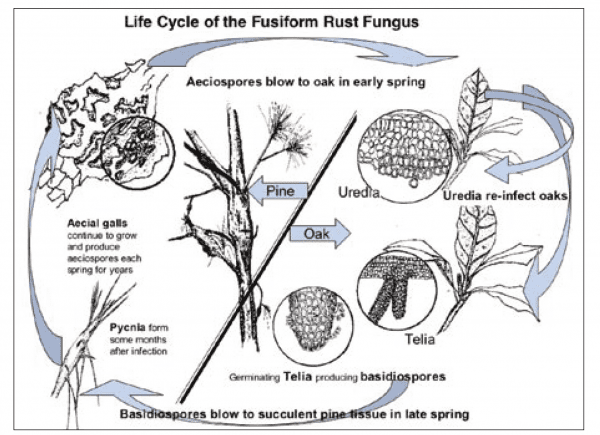
Life cyle of fusiform rust

Figure 1. Life cyle of fusiform rust

The most conspicuous stage in the life cycle is the orange-colored aeciospores that appear on pine galls. This occurs at the same time as the first flush of spring oak leaves (Figure 2). Aeciospores, if windblown to succulent oak leaves, establish infections that within a few days produce orange pustules (uredia) from which urediospores that reinfect oak leaves are produced. This spore stage builds up fungal inoculum for the next spore stage that appears a few weeks after the initial oak infection.
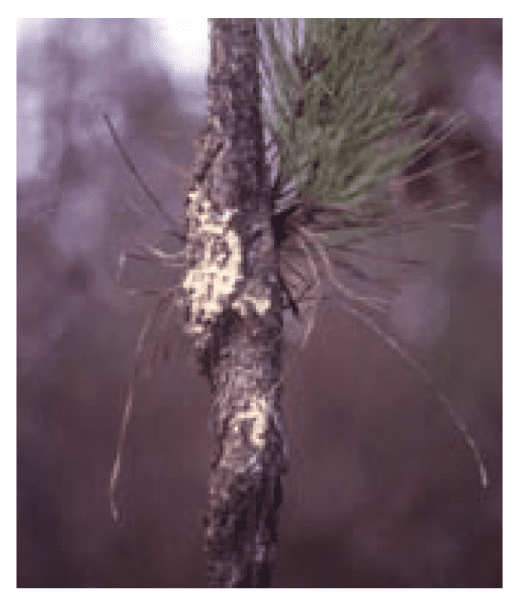
Spindle-shaped gall with orange-colored aeciospores.

Figure 2. Spindle-shaped gall with orange-colored aeciospores.

From each uredial infection on an oak leaf, the fungus produces a telia and the fourth spore stage, the teliospore (Figure 3), which germinates to produce basidiospores. The basidiospore is the threat to pines. Within a few months, if the spore is wind blown to succulent pine tissue and environmental conditions are adequate (24 hours of temperatures between 60 and 80 degrees F and relative humidity of 97 to 100 percent), a swelling or gall will start to develop at the site of infection.
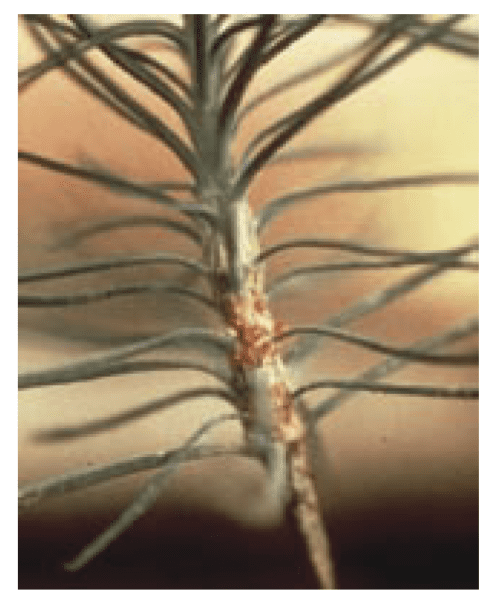
 Immature gall producing pycia that may cross fertilize the infection.

Figure 4. Immature gall producing pycia that may cross fertilize the infection.

A few months after basidiospores infect pine, another spore stage is produced, pycniospores (Figure 4). After cross fertilization within the pycnia, pyciospores establish the perennial gall that can produce the orange aeciospores again each spring for decades.

Identification

The fungus produces spindle-shaped galls on branches or main stems of pines. The galls are elongated with deep fissures. In the early spring, these galls produce orange-colored spores in bladderlike blisters (Figure 2). Many galls, which appear in late March to early April each year, may be present on a tree making the infection conspicuous. These yellow spores are no threat to the pine but rather serve to infect the alternate host, an oak. The most commonly infected oak species in Alabama are water, laurel, willow, and southern red. Oaks in the white oak group are rarely infected. Oak leaves become infected when the first flush is expanding in the early spring. On the underside of infected oak leaves, the fungus produces fine, inconspicuous hairlike structures (Figure 3). Severely infected oak leaves may have yellow spots but symptoms on oak leaves are usually not noticed.
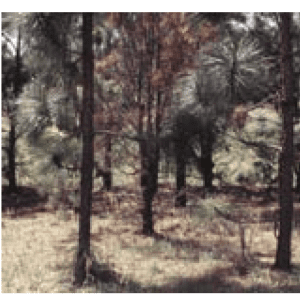
Loblolly pine with a lethal infection that appears to have occurred in the first year after out planting.

Figure 5. Loblolly pine with a lethal infection that appears to have occurred in the first year after out planting.

Fusiform rust infection of young pine seedlings is usually lethal within a few years. On larger trees, infection can cause multiple shoots that give the tree a bushy appearance (Figure 5). Older trees that survive with main-stem infections may develop a sunken canker (Figure 6), which causes a weak, distorted stem that can break in strong wind. Slash pine seems more susceptible to stem breakage than loblolly (Figure 7).
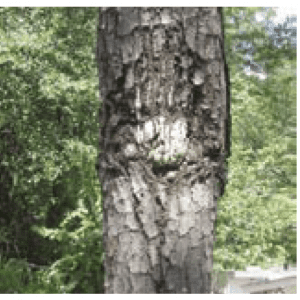
An old perennial gall on landscape tree. This increases chance for wind breakage.
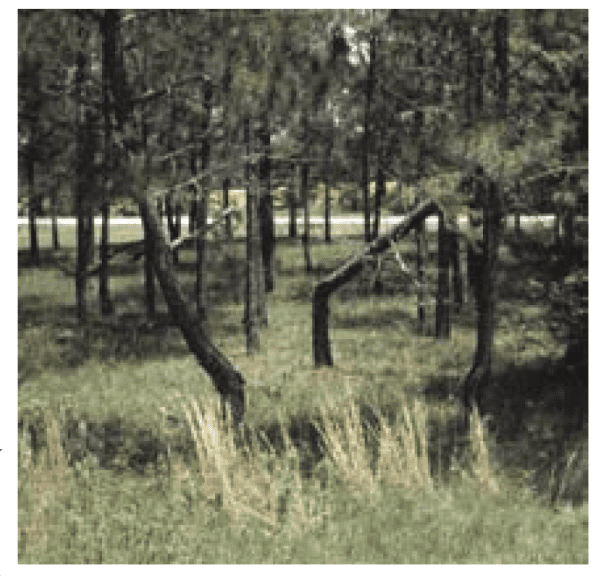
Figure 6. An old perennial gall on landscape tree. This increases chance for wind breakage.

Wind breakage of stems weakened by rust galls. Slash pine is more prone to breakage than loblolly pine.

Figure 7. Wind breakage of stems weakened by rust galls. Slash pine is more prone to breakage than loblolly pine.

Management

In forest-tree nurseries, seed treatments and timely foliar applications of a systemic fungicide have resulted in nearly 100 percent control of fusiform rust. However, once out of the nursery, fungicides are not economical and trees must rely on resistance and perhaps luck to avoid severe infections. Both slash and loblolly pine genetic improvements have increased rust resistance. Most pine seedlings available today are more rust resistant than were the seedlings planted 30 years ago.

Landowners should make sure that the loblolly and slash pine seedlings to be planted on their lands are disease free. Make sure the seedlings were treated for fusiform rust in the nursery, and, if possible before planting, examine seedling stems for slight swelling along the stem. This swelling strongly indicates a fusiform rust infection, and seedlings infected in the nursery will not survive more than a year or two in the field. If a stand is to be planted in an area with high incidence of fusiform rust (Figure 8), landowners should consider planting either rust resistant families of loblolly or slash pine or more resistant species such as longleaf or shortleaf pine. Rust resistant families of loblolly or slash pines are available from many forest-tree nurseries. Contact your state forestry commission or county Extension office for a list of nurseries that supply resistant pine material best suited for your area.

Infection after stand establishment can be minimized through various silvicultural options. One option is to reduce the site preparation necessary for stand establishment. Extensive site preparation and fertilization at the time of establishment tend to increase early pine growth, normally a desired objective, at a time when most infections will involve the tree’s main stem. Increased infection is due to increased succulent pine tissues (stems and needles) for a longer time when the basidiospores are present. If landowners fertilize after the pine trees are larger, typically 8 years old, fusiform rust infections tend to be farther away from the main stem and are less likely to cause main-stem damage.

In older stands, trees with main-stem rust cankers should be preferentially removed during any stand management thinning to reduce stem breakage and increase the growth of the neighboring uninfected trees. Trees with galls on the branches pose little or no threat to the stand and should be left to rotation. Main-stem infections pose a greater threat in landscape settings than they pose in forest situations. Such galls predispose their stems to breakage and should be removed if such breakage poses a threat to property. Slash pine is much more prone to breakage than is loblolly pine. In landscape settings, galls within 12 inches of the main stem on smaller trees can be pruned out to prevent the fungus from growing into the main stem. Branch infections more than 12 inches from the main stem typically pose no threat to the tree and can be left alone. Also, if infections have not resulted in a sunken canker, main-stem infections can be successfully pruned out if less than 50 percent of the circumference is affected. This is done by carefully removing the bark encompassing the galls and letting the healthy, noninfected bark callous over the removed area. In this way, the fungus is removed from the stem and the tree is able to compartmentalize the wound and eventually heal itself.
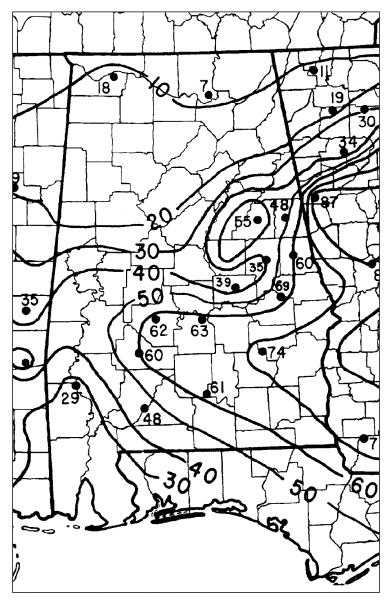
Percentage of trees infected with fusiform rust in 8- to 12-year-old loblolly pine plantations (from Squillance 1976).

Figure 8. Percentage of trees infected with fusiform rust in 8- to 12-year-old loblolly pine plantations (from Squillance 1976).

Summary

Loblolly and slash pine plantations intensively managed in the southern United States are susceptible to fusiform rust. Factors that increase infection include early rapid tree growth, warm moist conditions, and the presence of the alternate host. Minimizing site preparation; using resistant, disease-free planting stock; and delaying adding fertilizer until age 8 will help minimize infection in high-hazard areas. When thinning infected stands, stems with main-stem infections should be removed first because they have increased risk to wind breakage and reduced value. Those trees with only branch infections can be left alone. In landscape settings, main-stem infections on larger slash pine trees may pose a risk to property. On larger trees, branch infections can be left alone because they pose little threat of infecting the main stem. Also, homeowners may consider pruning out main-stem infections to remove the infection and save the tree.

Original post here https://ift.tt/2JVPyu7.


from Cairns Tree Lopping Pros https://ift.tt/2UqA43r
via IFTTT

Is Bot Canker Affecting Your Ornamental Trees?

Written by Kristi Waterworth and published on https://www.gardeningknowhow.com/.

Besides regular tree pruning and trimming, watching for the signs of disease is an important part of successful tree care. If you’re wondering if you should contact a tree arborist about a diseased tree on your property, then continue reading to learn how bot canker can affect ornamental trees. Bot canker, or Botryosphaeria dothidea, is an opportunistic fungus that is a serious pathogen among ornamental trees. This disease most frequently affects damaged and weakened trees, and environmental factors such as freeze injury, heat, drought, and soil compaction are examples of stressors that can make your trees more vulnerable to bot canker. This fungus commonly affects redbud, willow, elm, oak, hickory, holly, dogwood, cherry, apple, sweetgum, and Leyland cypress trees.

Botryosphaeria Canker Treatment – The Control Of Botryosphaeria Canker On Plants

It’s the greatest feeling in the world when your landscape is complete, the trees are big enough to cast a puddle of shade onto the lawn and you can finally relax after the years you’ve spent turning an old drab lawn into a planted paradise. When you notice that sad little plant in the corner, wilted and covered in dark spots, you’ll know it’s time to get back to work if you know how to recognize botryosphaeria canker on plants.

What is Botryosphaeria Canker?

Botryosphaeria canker is a common fungal disease of trees and woody shrubs, but it only attacks plants that are already stressed or weakened by other pathogens. Cankering can become quite extensive within the cambian layers, heartwood and inner bark of woody plants, cutting off the tissues that transport water and nutrients throughout the plant.
Affected tissues develop black, pimple-like fruiting structures or cankers on bark surfaces. When the bark is peeled back, the wood underneath will be reddish-brown to brown instead of a healthy white to pale green. Some trees will weep gummy sap or develop blisters on their bark along with the more obvious widespread wilting of botryosphaeria canker disease.

Control of Botryosphaeria Canker

If caught early, localized botryosphaeria canker on plants can be cut out and the entire plant saved. In the winter or very early spring before bud break, prune any branches or canes back to unaffected tissues and immediately dispose of infected debris. Prevent spreading the botryosphaeria fungus further by soaking pruning tools in a mixture of one part bleach to nine parts water for at least 10 minutes between cuts.
Fungicides aren’t generally recommended for botryosphaeria canker treatment, since the fungus penetrates tissues, where chemicals can’t reach. Instead, after pruning out diseased areas of the canopy, pay closer attention to the plant. Make sure that it is properly watered, fertilized and protect it from bark damage.
Once your plant is again thriving, you can keep it from developing new problems with botryosphaeria canker disease by continuing to provide it with excellent care and waiting to prune until late winter or early spring, when it’s still too cold for fungal spores to take hold while the wounds are healing.
Original post here https://ift.tt/36t7N1M.


from Cairns Tree Lopping Pros https://ift.tt/35eK060
via IFTTT

Understanding Insurance Benefits and Tree Removal

Written by Admin and published on https://www.harrinsurance.com/.

Anyone who has experienced a significant storm may have seen trees that have fallen over due to the wind, rain, and lightning. Sometimes trees fall down because they’re diseased. Whether the elements or a lack of tree care near Decatur and Atlanta were behind the fall, significant damages can occur when a heavy branch breaks. This is why it’s important to understand your insurance policy when it comes to tree removal. Depending on the circumstances, you may or may not be financially responsible for having the tree taken away. Read ahead if you could use some help understanding insurance benefits and tree removal .

A branch that falls from a tree won’t always cause damage, but heavy branches present significant potential for danger. A fallen branch may land on a car, your house, or even your body. There will be a cost to remove the fallen tree as well as a cost to deal with the damage, so you should know what your insurance policy will and will not cover. If your tree fell over because it was diseased, the insurance company should pay to repair any damage that occurred. However, you might have to pay to have the tree removed.

Will Your Home Insurance Pay for the Removal of a Dangerous Tree?

Mature trees block wind, create a sense of privacy, and cool your home by providing shade. Unfortunately, they’re also risk factors for damage to your home, any outbuildings on the property, your vehicles, and more. When you’re concerned about the condition of specific tree, you may wish your home insurance would cover the cost of removing it.

Tree removal terms vary by policy, but almost all home insurance providers share similar limitations on this particular process. Find out what you need to know about dealing with a dangerous tree, whether it’s still standing or has already fallen.

Before the Tree Falls

Many homeowners are surprised to learn that their insurance companies are not willing to pay for pre-emptive removal of diseased and dead trees. This is considered normal maintenance of the property, so cutting down these trees remains your responsibility as the owner. Even if removal would save money in the long run, insurance companies won’t approve tree removal ahead of a collapse.

Once you know a tree is a danger to your property or a neighbor’s home, you may become legally liable for paying for damages if you choose not to remove it. Don’t rely on your insurance company alone when you need to complete some routine tree removal and landscape maintenance around the home.

After a Fall

Most homeowner’s insurance policies cover both tree removal and repairs for damage after a tree falls. Yet there are still restrictions on coverage depending on where the tree falls and what kind of damage it does. Most policies pay for all damage caused by a tree, even when it doesn’t entirely fall but rather scratches or dents something instead.

On Covered Structures

Read your policy documents carefully to find out where a tree must fall to qualify for insurance coverage. Some policies stipulate that removal and repair is only offered when a limb or entire tree falls onto a covered structure. When this is the case, sheds and other outbuildings may or may not get excluded from the insurance policy.

A covered structure policy won’t reimburse you for costs related to cutting up and hauling away a tree that falls safely onto the lawn and causes no damage. If your policy is worded to cover tree removal from all covered surfaces instead, you may find your insurance company is happy to pay for removal of trees falling on your lawn, patio, and other exterior surfaces.

On a Neighbor’s Property

In most cases, you are not responsible for paying for a tree that falls on your property and damages a neighbor’s home. Unless you were cutting down the tree yourself or knew it was a liability and failed to act, the neighbor’s insurance company is responsible for the claim instead.

Your insurance policy may pay if you were somehow responsible for the tree falling, but you will also see a premium increase as a result. Trees that fall naturally, without warning, or due to storm damage are all the neighbor’s responsibility to deal with.

Onto Landscaping Features

Homeowner’s insurance policies that include coverage for certain outdoor surfaces also tend to pay for damage to flower beds, shrubs, other trees, and similar landscaping features. Just keep in mind that the deductible may already cover more than the value of replacement shrubs or trees. Not all insurance policies cover the labor of installation, so assess the damage before making a claim.

Original post here https://ift.tt/3nb7Gyt.


from Cairns Tree Lopping Pros https://ift.tt/3naJjRl
via IFTTT

Tuesday, November 3, 2020

The Dangers of Tree Removal

Written by Sarah Moore and published on https://homeguides.sfgate.com/.

Tree care work in general is hazardous, but tree removal is especially dangerous. Successfully felling a tree requires knowledge of tree physics, biology, dangerous tools, advanced cutting techniques, and more. Homeowners who attempt their own tree removal may be injured by falling limbs, malfunctioning equipment, or the tree itself.

Hazards of Cutting Trees

Keeping your property neat and beautiful sometimes necessitates the removal of a tree. Before you prepare to do so, however, make sure you know how to go about it in the safest way. Cutting down a tree poses many hazards that can be avoided by using proper techniques and observing safety precautions.

Falling

When cutting down trees, it is sometimes necessary to remove branches first. Perhaps the most obvious danger of working at heights is that of falling, especially if you are bending away from your center of gravity or using unwieldy tools. When using ladders, tie them to the tree you are working on securely before bringing up tools or beginning work. If you are high enough up that a fall to the ground could injure you, wear a fall-arrest harness attached to a thick, healthy branch with no signs of rot or cracking.

Being Hit By Branches or Trunks

As cutting down trees necessitates removal of branches and eventually the entire tree, you risk being hit by either. Have a helper assist you in bringing branches safely to the ground from upper heights, and remove all branches possible from ground level. When felling a tree, cut a third of the way through the tree parallel to the ground and then downward at a 60-degree angle to meet the inward end of the cut, creating a wedge. This will ensure that when you cut from the other side, the tree falls in the direction of the wedge.

Electrocution

Many trees are near power lines, and that puts you in danger if you need to remove them. Be especially careful when branches have grown out of control near telephone poles or power lines. Call the power company first to see if the lines can be shut off, or if they can ground out the lines or insulate them with blankets for you. Even so, take precautions so that you do not accidentally touch a line while working, as you can never be sure it is off.

Tool Injury

Although a chainsaw makes the work of cutting down a tree much easier, it is also a dangerous tool. Read the directions before you use it the first time and check that all is in order before each use. Manually remove anything that could cause the chainsaw to kick back at you, such as a nail or piece of rebar. Never cut directly overhead with a chainsaw, as you cannot always control its movement and don’t want it near your face or in a hard-to-control position.

Original post here https://ift.tt/34VUQho.


from Cairns Tree Lopping Pros https://ift.tt/329M6lS
via IFTTT

Tree Trimming & Pruning: Tips & Techniques

Written by Admin and published on http://www.thetreecareguide.com/.

By knowing the basics about tree trimming and tree pruning, you may be able to handle the majority of this kind of work yourself. There are a variety of great trimming tips and pruning techniques that can help keep your trees in excellent shape. With the right knowledge and equipment, you can prune your trees as necessary to maintain their appearance and health and to eliminate potentially dangerous dead branches and other common issues.

Tree Pruning Purpose, Techniques, and Safety

Tree trimming and tree pruning are relatively easy tasks if you know what to look for, how to make proper cuts, and when you should call a professional tree service.

The height, shape, and health of your trees can all be determined by the way you trim and prune them. Specifically, your tree’s health is directly affected by this process. A properly trimmed and pruned tree will thrive in its environment, while a poorly trimmed tree becomes more susceptible to disease, infestation, and fungi for the remainder of its life.

We at The Tree Care Guide have compiled a short, easy to understand list of tips to help you get this job done properly and safely.

Have A Good Reason to Prune

When it comes to pruning your trees, you should have a clear and specific objective. Just because it’s pruning season does not mean that you should just go cut your trees.

Most often we prune for these three principle reasons: health, safety, or aesthetics.

Health – When a tree falls victim to an infestation, fungal infection, or dieback, the tree can sometimes be saved by pruning away the infected areas. There is no wrong time for this type of pruning, as the greater stress on the tree would be to ignore and leave it.

Whereas pruning can be a response to danger, when performed proactively it can promote and improve a tree’s health. Tree crown thinning stimulates and benefits a tree’s health by allowing more air and sunlight to reach the inner leaves and branches.

Safety – Crossed branches that rub up against or bump each other in the wind should be trimmed back. This will avoid scaring, or one of them knocking the other to the ground, creating a serious hazard.

Another safety hazard may be caused by dead, brittle, or broken branches haphazardly dropping from the tree.

Another safety concern warranting pruning is when branches obstruct your line of sight of the sidewalk or road ahead. These limbs and branches should be trimmed back, cut off, or have the canopy be raised.

Lastly, trees that have grown too close to power lines are a hazard and major cause of damage in storms or severe weather. These situations should be dealt with only by a professional tree service or the local power company.

Aesthetics – The look of a tree can be greatly enhanced and influenced through regular pruning. Be cautious though, trying to create a topiary could influence you to trim too deep, seriously damaging the tree.

Tree Pruning – Raising the Crown

Crown raising is the pruning and removal of the lowest branches of a tree.

  • Younger trees respond well to this action by developing more growth in the upper branches.
  • For older trees, be cautious. Their crown branches will be much larger, leaving larger wounds and greater potential for infection or infestation.

Raising the crown of a tree is generally performed to provide clearance for pedestrians, vehicles, or improving the line of sight for roadways and sidewalks.

Tree Pruning – Thinning the Crown

Crown thinning is the selective and careful removal of branches within the crown. This option provides great relief to trees that continuously sustain strong wind or have to carry the weight of accumulated snow and ice.

  • Prune away branches that cross or are in contact with other branches.
  • Branches should be evenly spaced, creating both symmetry and balance.
  • Improper or over thinning can leave your tree susceptible to decay and disease.

Note – Extensive crown thinning should be performed over a series of years. Removing more than a quarter of the crown at once may cripple or kill the tree.

Tree Pruning – Cleaning the Crown

Cleaning the crown is the process of removing the dead or dying branches, which is a proactive tree care approach that often produces a healthier and longer lasting tree.

Crown cleaning removes unnecessary weight, stops the spread of decay, and drastically reduces the danger of falling branches.

  • If more than half of the foliage of a branch is to be removed, remove the entire branch.
  • If you are considering removing more than a fourth of the crown due to its damage, contact a tree professional to assess the situation; there may be an underlying issue affecting the tree’s health.

Tree Pruning – Height Reduction

Properly reducing the height of a tree requires precision pruning. Irreparable damage may be done to the tree if performed improperly.

  • Know the species and growth pattern of your tree. Depending on the species, height reduction may lead to serious damage and the death of the tree.
  • Avoid “topping” the tree. Topping or cutting broadly across the top and through the main trunk can lead to the decline of the tree’s health and eventual death. In such a situation, where the height is problematic, consider removing or relocating the tree.
  • When it comes to height reduction, seek the assistance of a trained arborist or tree care professional. More often than not, this procedure (done incorrectly) will cause more problems than solutions.

Tree Pruning – Cutting Techniques

Make sure that your tools are sharp and that you are taking the proper safety precautions when using them.

  • Your cuts should be clean.
  • Avoid using tree wound paint to cover cuts. Typically the tree will react to the cut by closing it’s wound off and healing itself.
  • For larger branches that have formed a “branch bark ridge” and “collar”, cut just outside the bark ridge and collar without leaving a protruding stub.
  • If the limb or branch is smaller and has not formed a collar, cut close to the base.
  • For shortening a small branch, locate a lateral bud or an already developed lateral branch that is growing in an outward direction. Make a clean cut at a slight angle with the base of the cut a quarter of an inch past the bud or branch.

If the job is questionable, extensive, or the tree is large, it should more than likely be performed by a professional tree service.

Pruning Safety and Common Sense

Now that you have a better idea of the work to be accomplished, have at it and keep these safety points in mind:

  • Always use protective eyewear, gloves, and sturdy clothing.
  • Make sure there is nothing below the crown, even the lightest branches can hurt hey person or a pet.
  • Never make a cut that leaves you in the “drop zone”.
  • Don’t make cuts that you are unsure about.
  • If the job is more extensive than originally planned, or risks compromising the stability and health of the tree, call a tree service for help.

Tree Pruning

Tree pruning is a technical approach to cutting a tree to shape it, provide clearance, or remove dead, disease, and damaged branches.

Always begin your pruning project with a clear vision of the results you desire, make proper cuts, and know when to stop.

When performed properly, pruning can improve the health and appearance of a tree. Conversely, an improper pruning job can damage or kill an otherwise healthy and thriving tree.

Original post here https://ift.tt/2U3tqzX.


from Cairns Tree Lopping Pros https://ift.tt/3jYBiNj
via IFTTT